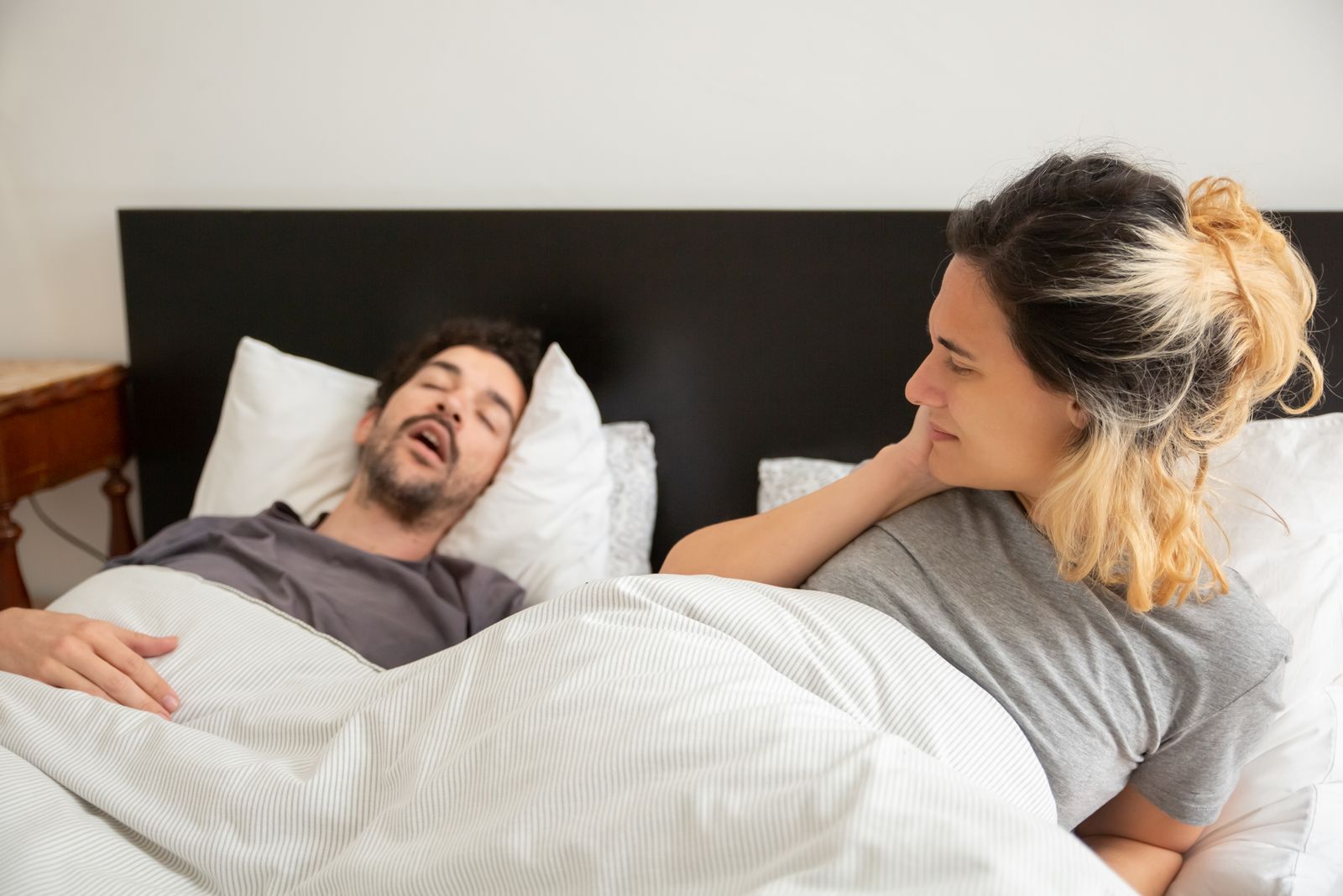
TCM for Snoring and Obstructive Sleep Apnea: Phlegm-Damp Patterns, Acupressure, Herbal Research, and Why CPAP Comes First (2026 Guide)
Cover image source: Pexels (photo by Kampus Production)
🌿 A gentle note from us
The practices shared here are rooted in Traditional Chinese Medicine traditions that have been passed down for thousands of years. We share them as educational resources — not as prescriptions or medical advice.
Every body is different. What brings balance to one person may not be right for another. Please listen to your body, go gently, and check with a qualified healthcare provider before trying any new wellness practice — especially if you are pregnant, managing a chronic condition, or have specific health concerns.
Some links on this site are affiliate links. If you choose to purchase through them, we may earn a small commission at no extra cost to you. This helps us continue sharing ancient wisdom for modern wellness. Thank you for your trust.
Nearly a billion adults aged 30–69 worldwide were estimated to have obstructive sleep apnea: 936 million, including 425 million with moderate-to-severe disease, in a 2019 global analysis. Many cases remain undiagnosed. Treating snoring as a joke or a bedroom annoyance can distract from the breathing pauses that deserve attention. Traditional Chinese medicine offers a framework and emerging research to discuss, while sleep testing and established treatment remain the priorities.
Snoring is not the same as sleep apnea
Snoring alone does not establish an OSA diagnosis. In sleep apnea, breathing repeatedly stops and resumes. NHLBI explains the distinction: obstructive sleep apnea involves recurrent upper-airway blockage; central sleep apnea involves inadequate brain signals to breathe. OSA is the more common form. Obesity, enlarged tonsils, and hormonal changes can contribute to airway narrowing.
Witnessed breathing pauses, gasping, unrefreshing sleep, and daytime sleepiness deserve assessment. Diagnosis requires a clinician-directed sleep study; home testing is available for many patients, as the American Heart Association’s 2021 statement summary explains.
The apnea-hypopnea index (AHI) counts apneas plus hypopneas per hour of sleep. The following bands reproduce those reported in the 2020 acupuncture review; a clinician should interpret an individual sleep report, including boundary values.
| Severity | AHI, events per hour |
|---|---|
| Mild | 5–15 |
| Moderate | 16–30 |
| Severe | More than 30 |
Why it matters beyond tiredness
The AHA summary reports OSA in 40%–80% of people with cardiovascular disease, 30%–50% with hypertension, and up to 80% with resistant hypertension. It also cites estimates of 34% of middle-aged men and 17% of middle-aged women meeting OSA criteria. These figures describe different populations, not an individual’s probability.
The relationship can reinforce itself: OSA worsens cardiovascular conditions, which can worsen OSA. NHLBI warns that untreated sleep apnea raises stroke and heart attack risk and can affect memory, concentration, and decision-making. Daytime sleepiness also creates a driving safety concern. Anyone struggling to stay awake should avoid driving and arrange prompt assessment.
How TCM traditionally frames snoring and sleep apnea
TCM uses pattern differentiation to describe a person’s presentation. Phlegm-dampness (痰濕, tan shi) and spleen deficiency (脾虛, pi xu) are targets of the phlegm-resolving approach examined in the 2022 OSA herbal review.
A 2026 Frontiers in Medicine review describes the traditional relationship in which phlegm formation is attributed to the spleen system and its accumulation to the lung system. That paper concerns COPD mucus hypersecretion, not OSA. It supplies historical framework here, not evidence that an herbal approach treats sleep apnea. The TCM spleen and digestion guide provides related background.
These are traditional pattern labels describing a presentation, not diagnoses of structural airway obstruction or findings about the anatomical spleen. Snoring with breathing pauses needs a sleep study. A pattern label cannot establish severity or show that an airway stays open during sleep.
What herbal and acupuncture research actually shows
Phlegm-resolving herbal therapy
The 2022 meta-analysis included 13 randomized trials and 882 patients. Adding phlegm-resolving TCM therapy to CPAP improved AHI, Epworth Sleepiness Scale (ESS) scores, and lowest oxygen saturation compared with CPAP alone. Adding it to health guidance also performed better than health guidance alone on these measures.
Longer courses, beyond six weeks, appeared better for sleepiness and lowest oxygen saturation; shorter courses appeared slightly better for AHI. None of those duration differences was statistically significant. Only one study reported an adverse event: mild nausea in one participant. Sparse reporting cannot establish safety. These findings support further study of supervised adjunctive care, not a formula to select independently.
Acupuncture: encouraging signals, uncertain confidence
A 2016 review of six randomized trials with 362 participants, summarized in the 2020 review, found improvements in breathing indices with manual acupuncture and electroacupuncture. Limited evidence prevented a definite conclusion about manual acupuncture versus nasal CPAP.
The 2020 analysis included nine trials and 584 participants. Mean differences favored acupuncture for AHI by −6.18 events/hour (95% CI −9.58 to −2.78) and ESS by −2.84 points (95% CI −4.80 to −0.16). Moderate and severe OSA subgroups showed larger effects. However, GRADE certainty was low to very low, and the trials did not report acupuncture side effects. Better trials remain necessary.
Commonly needled points were Zhaohai (KI6), Sanyinjiao (SP6), Sishencong (EX-HN1), Shenmen (HT7), Zusanli (ST36), and Lianquan (CV23). The studies used practitioner techniques including needle retention and deqi responses. These protocols are not home instructions.
A 2025 network meta-analysis covered 43 randomized trials and 3,402 patients with sleep apnea syndrome. Against placebo, electroacupuncture reduced AHI by −9.80 events/hour (95% credible interval −16.89 to −2.74); manual acupuncture by −6.29 (−10.55 to −2.06).
Its rankings varied by outcome:
| Outcome | Highest-ranked approach | SUCRA |
|---|---|---|
| AHI reduction | Electroacupuncture | 86.0% |
| Shorter longest apnea | Acupoint catgut embedding | 98.7% |
| Higher lowest oxygen saturation | Acupoint catgut embedding | 89.7% |
| Less daytime sleepiness | Manual acupuncture plus herbal decoction | 87.6% |
| Overall effectiveness rate | Manual acupuncture plus Western medicine | 79.8% |
| Fewest adverse events | Herbal decoction alone | 93.4% |
SUCRA summarizes ranking within the network; it is not a patient’s chance of success. Most trials came from China, blinding and allocation concealment were often inadequate, and follow-up was usually short. Safety rankings inherit weaknesses in adverse-event reporting.
The authors propose activation of the hypoglossal motor nucleus and greater upper-airway muscle tone as a mechanism. This remains a proposed explanation. Modest AHI reductions do not establish equivalence to CPAP, and are smaller than the medication-trial changes below; comparisons across separate studies are not head-to-head tests. Catgut embedding, electroacupuncture, and moxibustion require practitioners and should never be attempted at home.
What carries the strongest evidence today
PAP and individualized alternatives
CPAP and other positive airway pressure approaches remain mainstays of OSA care. AASM Sleep Education describes CPAP as the frontline treatment for sleep apnea: a machine that uses a steady stream of air, delivered through a mask and hose, to keep the airway open through the night. This directly addresses the obstruction while the device is in use. The AHA statement summary says screening should be followed by treatment as appropriate, which may include CPAP, oral appliances, lifestyle changes, and weight loss. Follow-up helps establish whether treatment works.
Adherence matters: prescribed equipment needs to be used as directed. Difficulty tolerating PAP warrants a conversation with the sleep team about making treatment workable, not an unsupervised switch to herbs. AASM Sleep Education explains treatment choices and follow-up.
Weight reduction and prescription research
On December 20, 2024, the FDA approved Zepbound, or tirzepatide, for moderate-to-severe OSA in adults with obesity, alongside reduced-calorie eating and increased physical activity. It was the first drug treatment option approved for this group.
The SURMOUNT-OSA trials enrolled 469 participants across two phase 3, double-blind randomized studies lasting 52 weeks. Average starting AHI was 51.5 and 49.5 events/hour, respectively.
| Trial population | AHI change with tirzepatide | AHI change with placebo |
|---|---|---|
| Not using PAP at baseline | −25.3 events/hour | −5.3 events/hour |
| Using PAP at baseline | −29.3 events/hour | −5.5 events/hour |
Treatment differences were −20.0 (95% CI −25.8 to −14.2) and −23.8 (−29.6 to −17.9) events/hour. Weight fell approximately 18%–20%. This demonstrates an evidence-based role for weight reduction in the studied population; prescribing remains a clinician’s decision. It is not a self-treatment plan or a recommendation to take this drug. Related context appears in the TCM weight-management guide.
Mouth and throat exercises: mixed findings
A 2015 myofunctional-therapy review included nine adult studies with 120 patients. Mean AHI fell from 24.5 to 12.3 events/hour, with improvements in snoring and lowest oxygen saturation.
A 2025 review included 15 randomized trials involving 473 adults and 139 children. Its pooled AHI change was not statistically significant: −8.73 events/hour (95% CI −21.19 to 3.74; P=0.17). Sleepiness improved by 3.54 ESS points and sleep quality by 2.24 PSQI points. AHI benefit appeared with daily practice exceeding 30 minutes, a subgroup finding rather than a guaranteed threshold. The older positive result and newer uncertainty belong together when discussing supervised exercises.
The nose, alcohol, and the season
Research on chronic nighttime congestion links it with habitual snoring, including snoring without apnea. The nose deserves attention when colder months bring congestion or respiratory illness. Persistent blockage is a reason to discuss appropriate care; the sinus-pressure guide offers related reading. AASM’s patient information also explains that alcohol can worsen airway collapse. Evening alcohol use belongs in the sleep assessment.
Autumn itself should not be blamed. A 2025 seasonal study found northern-hemisphere AHI approximately 5% higher in summer and winter than in spring and autumn. Patterns varied between countries, and the physiology remains unsettled.
Acupressure at home: comfort, not a treatment
The acupuncture trials tested practitioner needling. Direct evidence for self-applied acupressure in OSA is essentially absent from these sources. Feeling relaxed after touch does not demonstrate improved breathing or oxygen levels.
For optional comfort, a qualified practitioner can first identify accessible HT7, KI6, SP6, and ST36 points. Once identified, the following gentle routine is an option, not a research-tested OSA protocol:
- Sit comfortably and use only light fingertip pressure at an identified point.
- Keep pressure comfortable for 20–30 seconds, then release before moving on.
- Stop immediately if anything hurts or feels unpleasant; practice once daily at most.
Never press the front of the throat: leave CV23/Lianquan alone. Avoid strong pressure anywhere on the neck. If pregnant or possibly pregnant, do not self-treat SP6 or any of these points without professional advice. Do not guess point locations.
Comfort basics include awareness of side-sleeping, addressing a blocked nose appropriately, relaxed breathing, and regular sleep timing. None confirms control of OSA. The acupressure and insomnia guide concerns a different sleep complaint and should not be treated as apnea evidence.
When to see a doctor
Arrange medical assessment for:
- Loud snoring accompanied by witnessed breathing pauses.
- Gasping or choking awakenings.
- Falling asleep while driving or during daytime activities.
- Morning headaches or unrefreshing sleep.
- Blood pressure that remains high despite treatment.
- Atrial fibrillation or heart failure, especially with sleep-related symptoms.
- Snoring in a child.
Bring a bed partner’s account and a record of symptoms. These observations help the conversation; they do not replace testing. TCM support must never delay a sleep study. Do not stop or refuse prescribed PAP therapy in favor of herbs or acupressure.
Safety of herbs and needles
NCCIH’s TCM safety guidance describes products containing undeclared drugs, heavy metals, pesticides, or incorrectly identified ingredients. Herbs can also interact with medicines. A qualified practitioner and the treating clinician should review any proposed formula and the complete medication list together.
Serious needling complications are uncommon, but NCCIH’s acupuncture guidance identifies infection and organ injury from improper technique or nonsterile needles. Choose a qualified practitioner using sterile, single-use needles. Limited adverse-event reporting in OSA trials cannot substitute for these precautions.
A practical next step
Start with NHLBI’s sleep apnea overview or AASM Sleep Education for assessment and treatment basics, and consult NCCIH for complementary-approach safety. Bring questions about TCM patterns into a coordinated care conversation instead of selecting herbs independently.
The useful takeaway is a clear order of priorities: investigate breathing pauses, establish effective OSA care, and judge complementary options by both evidence and safety. A calmer bedtime or quieter snoring alone cannot confirm that apnea is controlled.
TCM approaches are complementary and must not delay medical assessment or treatment.