TCM for Menopause: Herbs, Acupressure & Lifestyle Habits for Hot Flashes and Better Sleep
Medical Disclaimer: This article is for educational purposes only and is not medical advice. Hot flashes, night sweats, and sleep problems can also be caused by thyroid disease, anemia, or other treatable conditions — have a doctor check first. Always consult a qualified TCM practitioner before taking herbs, especially if you have a history of breast or ovarian cancer, liver disease, or take blood-thinning medication.
The 2 a.m. wake-up is a signature of the menopausal transition: sheets soaked, skin prickling with heat, sleep gone for the night. Hot flashes affect up to 75% of women going through menopause, and many of those flashes land at night, dragging sleep quality down with them (Ee et al., 2016). If that sounds familiar, you have probably already tried the usual advice — lighter bedding, cooler rooms, cutting caffeine. And you may be wondering whether Traditional Chinese Medicine (TCM) has anything real to add.
It may help some people, but not in the way most “menopause supplement” marketing suggests. TCM does not traditionally frame menopause as a disease or a hormone deficiency to be topped up. It views it as a natural life transition in which the body’s cooling and moistening system — what TCM calls yin — runs low, and the Kidneys, which govern the reproductive cycle in this framework, enter a stage of gradual decline.
This guide walks through the four tools TCM actually uses for this transition: the herbs that appear in classical formulas, the acupressure points you can press yourself in bed, food therapy that cools from the inside, and lifestyle habits that protect sleep. It also says plainly where the research is strong, where it is mixed, and when self-care is not enough.
How TCM Sees Menopause: Kidney Yin and “Empty Heat”
The classical foundation appears in the Huangdi Neijing (Yellow Emperor’s Classic of Internal Medicine), written more than 2,000 years ago. It describes a woman’s reproductive life unfolding in seven-year cycles, with the essence that supports menstruation — called Tian Gui — becoming scarce around the seventh cycle, roughly age 49. Menopause, in this view, is not a failure of the body. It is the scheduled completion of one chapter of the life cycle.
The mechanism behind hot flashes is where the model gets practical. TCM divides the body’s energies into yin (cool, moist, substantial) and yang (warm, active, bright). Think of the body as a radiator: yang is the fire, yin is the coolant. When coolant runs low, the engine overheats in sudden surges even though nothing is mechanically broken. That is the TCM picture of a hot flash: empty heat rising because the yin foundation has thinned, especially in the Kidneys and Liver.
This is also why nights are worse. Yin’s job is to anchor yang when activity winds down. When yin is weak, yang floats upward and outward instead of settling, so sleep fractures, dreams get vivid, and 2 a.m. arrives with a rush of heat. Night sweats are, in TCM language, the same empty heat escaping through the surface.
Notably, this is not just folklore. The largest sham-controlled trial of acupuncture for hot flashes enrolled women who met the Chinese medicine diagnosis of kidney yin deficiency — the researchers treated exactly the pattern described above (Ee et al., 2016).
Herbs for Menopause: What Practitioners Actually Prescribe
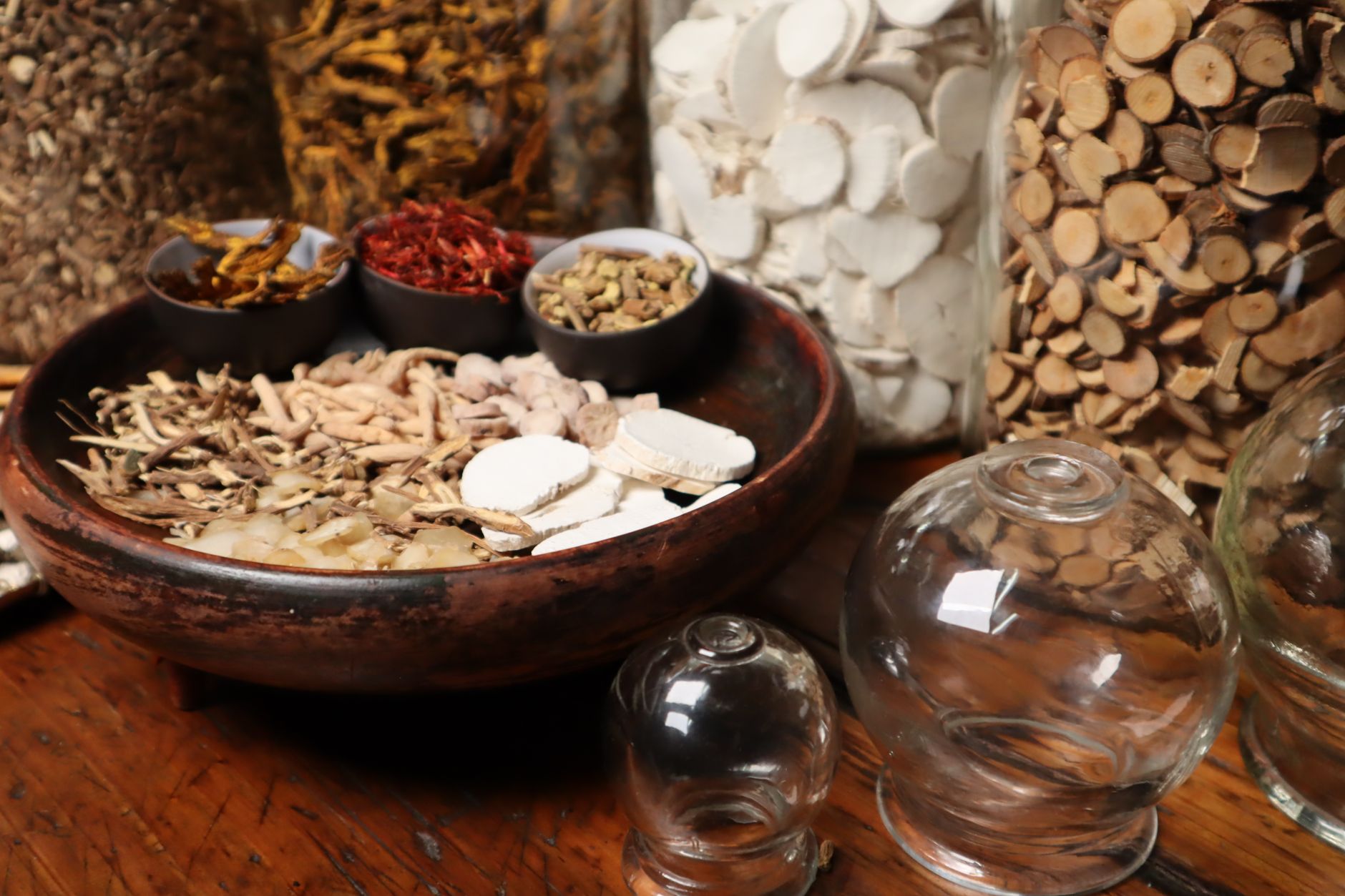
Here is the honest part about herbs. In TCM, single herbs are the exception; formulas are the rule. And the most famous “menopause herb” of all, dang gui, fails when tested alone: a double-blind, placebo-controlled trial of dong quai (dang gui) in postmenopausal women found it no more effective than placebo for hot flashes and other symptoms (Hirata et al., 1997). That result makes sense within TCM logic — dang gui is a blood mover, not a stand-alone yin tonic. It works in combination, not isolation.
| Herb | TCM role | Typical use in menopause | Caution |
|---|---|---|---|
| Dang Gui (Angelica sinensis) | Tonifies and moves blood; the classic “women’s herb” | Paired with bai shao and shu di huang in blood-nourishing formulas | Can promote bleeding; never take solo for months; get oncology sign-off if you have had estrogen-sensitive cancer |
| Shu Di Huang (prepared rehmannia) | Nourishes Kidney yin and blood | Core of Liu Wei Di Huang Wan (Six Flavor Rehmannia Pill), a classic formula for yin deficiency | Heavy and cloying; best in formulas, not as a lone supplement; may dull digestion at high doses |
| Bai Shao (white peony root) | Softens the Liver, calms irritability and mood swings | Balances dang gui’s warmth; helps night sweats | Generally gentle; keep high doses under a practitioner’s eye |
| Suan Zao Ren (sour jujube seed) | Calms the spirit (shen) and supports sleep | The heart of Suan Zao Ren Tang, TCM’s best-known insomnia formula | Works gradually over weeks, not like a sleeping pill; no driving impairment, but no instant fix either |
| He Shou Wu (Polygonum multiflorum) | Historically used to tonify essence and counter graying | Sometimes added to anti-aging formulas | Real safety signal: the raw form has been linked to liver injury in case reports. Only processed (zhi) forms, short courses, practitioner supervision |
A sentence every reader should keep: herbs are medicine, not vegetables. Dang gui and other blood-moving herbs can amplify the effect of warfarin and similar blood thinners, and several TCM herbs show estrogen-like activity in laboratory studies. Self-prescribing from an internet list is how people get hurt. A licensed practitioner selects, doses, and monitors the formula.
Acupressure Points for Hot Flashes and Better Sleep
The acupuncture evidence for menopause is genuinely mixed — and worth understanding before you spend money. A 2015 meta-analysis of 12 trials covering 869 women found that acupuncture significantly reduced hot flash frequency and severity and improved quality of life (Chiu et al., 2015). But the large 2016 sham-controlled trial found real acupuncture no better than sham — with both groups improving substantially (Ee et al., 2016). The fair reading: needle or not, structured, repeated stimulation of these points is associated with meaningful improvement for many women, and it is low-risk.
Acupressure is the self-care version — the same points, a thumb instead of a needle. Technique: press firmly but not painfully, make slow circles for one to two minutes per point, repeat on both sides, and breathe slowly throughout. Do this once or twice a day, ideally in the evening before bed.
| Point | Plain-language location | Used for |
|---|---|---|
| SP6 Sanyinjiao (Three Yin Crossing) | Four finger-widths above the inner ankle bone, just behind the shin bone | Hot flashes, sleep, hormonal balance — the classic “women’s point.” A 2020 systematic review of single-point SP6 stimulation found improved sleep quality, longer deep sleep, and longer REM sleep in people with insomnia (Wang et al., 2020) |
| LI4 Hegu (Union Valley) | In the fleshy web between thumb and index finger | Head heat, tension, pain, frustration |
| LR3 Taichong (Great Surge) | Top of the foot, in the dip between the first and second toe bones | Irritability, “rising heat,” stress — pairs naturally with LI4 |
| KI3 Taixi (Great Stream) | Midway between the inner ankle bone and the Achilles tendon | Kidney yin support, night sweats, low energy |
| GV20 Baihui (Hundred Meetings) | Top of the head, halfway between the tips of the ears | Calming the mind and settling sleep |
One traditional caution: LI4 and SP6 are classically avoided with strong stimulation during pregnancy. If you are pregnant or trying to conceive, get guidance before pressing them.
Food Therapy: Eating for Cooler Nights
TCM food therapy for menopause follows one principle: moisten and cool instead of fanning the fire. Start with the foods that appear in nearly every yin-nourishing kitchen:
- Black sesame — TCM food logic says black foods feed the Kidneys; sesame is the standard for blood and yin nourishment, and it doubles as a gentle laxative for the dryness many menopausal women notice.
- Goji berries (gou qi zi) — sweet and neutral, they nourish Liver and Kidney. A small handful simmered into congee or porridge beats a sugar-laden “energy bar” every time.
- Chinese yam (shan yao) — a gentle tonic for both qi and yin, easy on the stomach, and a staple of congee for women in transition.
- Millet and rice congee — slow-cooked, easy to digest, and naturally cooling; the classic evening meal in Chinese food therapy.
Equally important is what to cut. Spicy food, alcohol, coffee, and late heavy meals all fan yang and can trigger a flash within an hour. Try a simple tracking rule: if a food makes you feel hot within 30 minutes of eating it, it is feeding your heat — reduce it for two weeks and watch what changes.
Lifestyle Habits That Move the Needle
- Sleep environment: keep the bedroom at 18–20°C (64–68°F), wear cotton layers you can peel off without fully waking, and set one consistent bedtime — even on weekends.
- Evening wind-down: a warm (not hot) shower, a few minutes pressing SP6 and GV20, and screens off 45 minutes before bed. Treat the pre-sleep hour as a ritual, not leftover time.
- Breathing for flashes: at the first surge of heat, breathe in for four counts and out for six. This directly steadies the nervous system during the 90 seconds a flash typically lasts.
- Movement: unlike high-intensity workouts, which fan heat, tai chi and qigong train the body to move without overheating. Evening walks beat evening HIIT for this stage of life; the goal is to drain stress, not add fire.
- Stress: worry is a documented flash trigger for many women. If your flashes cluster on stressful days, treat stress management as part of the treatment, not a bonus.
When to See a Licensed TCM Practitioner
Self-care covers a lot, but three situations call for professional help. First, see a doctor before anything else if you have bleeding more than 12 months after your last period, pelvic pain, or symptoms severe enough to disrupt work and life — herbs will not fix a structural problem. Second, seek a licensed TCM practitioner (in the US, NCCAOM board certification is the gold standard) if your symptoms persist beyond about three months of consistent self-care, or if you want herbal therapy — dosing, formula choice, and interactions are exactly what training is for. Third, if you have a history of breast or ovarian cancer, coordinate every herb through a practitioner who works with your oncologist. The TCM tradition has real tools for this transition; it also has real potency, and the safest path is the one that respects both facts.
Start tonight with what is free and safe: press SP6 before sleep, cool the bedroom, and swap the late coffee for goji congee. For the deeper questions — which formula fits your pattern, what dose, for how long — bring them to a qualified practitioner.
For balanced, evidence-based reading before you go, the National Center for Complementary and Integrative Health’s overview of acupuncture and its in-depth page on menopausal symptoms are excellent starting points, alongside the trial reports linked throughout this article.
Related reading: TCM for Women’s Health: Menstrual Wellness, Herbs, and Acupressure · Acupressure for Insomnia
Health & Safety Notes
- This content is educational wellness information, not medical advice or diagnosis.
- Suitable for: general adult self-care reference.
- Consult a qualified practitioner before use if you are pregnant, nursing, have a chronic condition, take medication, or treat children.
- Red flags — seek medical care if: symptoms are severe, worsening, or persistent; sudden or unexplained pain; fever; numbness/weakness.
- Information reviewed: 2026-09. Sources: traditional Chinese medicine references and general wellness literature.