TCM for Knee Pain: Acupoints, Herbs, and the Wind-Damp Pattern Behind Arthritis
Medical Disclaimer: This article is for informational and educational purposes only. It does not constitute medical advice and is not a substitute for professional diagnosis or treatment. Always consult a qualified TCM practitioner or your doctor before using herbal formulas, moxibustion, or acupressure, especially if you are pregnant, nursing, taking medication, or have an existing health condition.
Knee pain tends to arrive with the cold and the damp — a stiff, aching joint that complains more on rainy mornings and after long periods of rest. Western medicine usually calls this osteoarthritis or rheumatoid arthritis. TCM for knee pain reads the same aching joint through a different lens, one centered on Bi syndrome (痺證), a painful obstruction caused by Wind, Cold, and Dampness lodging in the joint.
The TCM View: Wind-Damp Bi Syndrome (痺證)
In classical Chinese medicine, “Bi” means blockage or obstruction. The oldest texts describe it plainly: Wind, Cold, and Dampness invade the body together and settle in the joints, where they block the flow of Qi and blood. That blockage produces the hallmark symptoms of arthritic knee pain — stiffness, aching, swelling, and pain that worsens with cold or wet weather.
Practitioners further divide Bi syndrome by which pathogen dominates. A Wind-predominant (行痺) pattern brings pain that moves from joint to joint. A Cold-predominant (痛痺) pattern brings severe, fixed pain that improves with heat. A Damp-predominant (著痺) pattern brings heaviness, swelling, and a knee that feels wrapped in a wet towel.
In the TCM framework, many chronic knee-arthritis presentations are described under Wind-Damp or Cold-Damp patterns. Traditional care aims to disperse those patterns and support the conceptual circulation of Qi and blood through the joint; these terms do not describe a proven anatomical mechanism.
Underneath these pathogens, TCM usually finds an underlying deficiency. The Liver governs the sinews and the Kidneys govern the bones. When Liver blood and Kidney essence weaken with age, the joints lose their nourishment and become easy targets for invading pathogens. Effective treatment therefore warms and expels, but also nourishes what age has depleted.
TCM for Knee Pain: The Four Acupoints That Matter Most
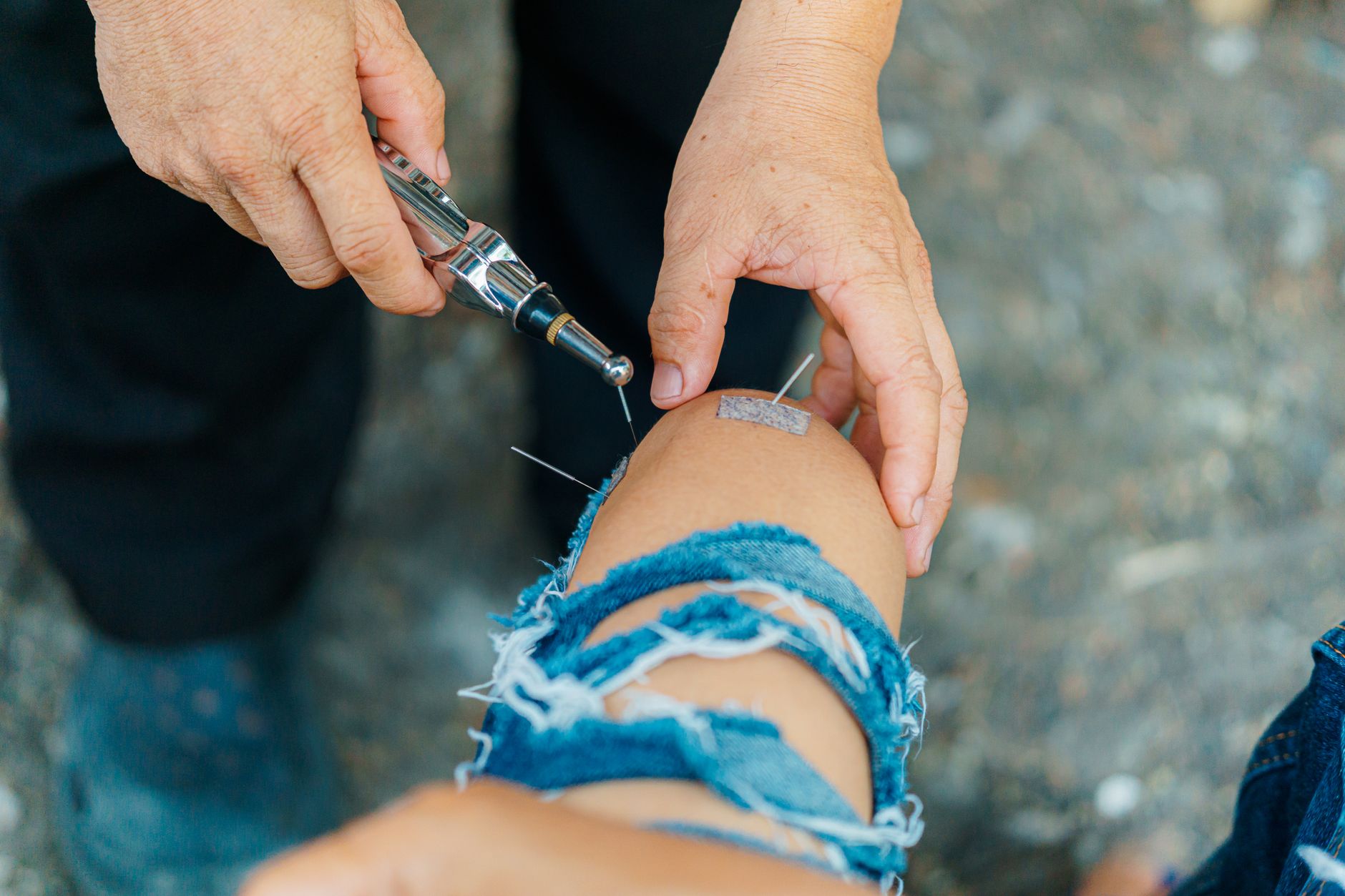
Acupressure and acupuncture work on the knee by unblocking local Qi and drawing fresh blood into the joint. Four points are used again and again for Wind-Damp knee pain. Press each with steady thumb pressure for one to two minutes, breathe slowly, and repeat on both legs.
ST35 Dubi (犢鼻) — The Calf’s Nose
Location: In the hollow just below and to the outside of the kneecap, beside the patellar tendon. It is easiest to find with the knee slightly bent.
Dubi is the master point for the knee joint itself. It sits directly over the joint space, which makes it the first point to work for any localized knee pain. In modern terms it targets the structures around the patellar tendon and the joint capsule, helping release the tight, tender tissue that stiffens the knee.
EX-LE4 Neixiyan (內膝眼) — The Inner Eye of the Knee
Location: The matching hollow just below and to the inside of the kneecap, opposite ST35.
Together with Dubi, Neixiyan forms the famous pair known as the “Eyes of the Knee” (Xiyan). Pressing both hollows at once with the thumb and index finger brackets the joint and is a simple, effective move for morning stiffness and swelling. These two points are where dampness most often pools around the knee.
GB34 Yanglingquan (陽陵泉) — The Yang Mound Spring
Location: In the depression just below and in front of the head of the fibula, the small bone on the outer side of the lower leg.
Yanglingquan is the influential point for the tendons and sinews — the tissue TCM says the Gallbladder meridian and the Liver govern. It is the go-to point when knee pain is more about stiffness and reduced range of motion than swelling, and it is frequently paired with ST35 for osteoarthritis of the knee.
SP10 Xuehai (血海) — The Sea of Blood
Location: On the inner thigh, about two finger-widths above the inner corner of the kneecap, on the bulge of the vastus medialis muscle.
Xuehai means “Sea of Blood,” and its job is to invigorate blood and clear heat from the joint. It is especially useful when the knee feels warm, swollen, and inflamed, or when pain has a stagnant, bruise-like quality. In Wind-Damp patterns it helps move the blood that the pathogen has congested.
For a broader view of pressing the knee, see our dedicated acupressure for knee pain guide.
Warming Herbs for Wind-Damp Knee Pain
The classic formula strategy for Wind-Damp Bi syndrome is to dispel the pathogen while supporting the Liver and Kidneys. Three herbs appear constantly in these formulas, and they illustrate the logic well.
Duzhong (杜仲, Eucommia bark) is traditionally used to support the Liver, Kidneys, sinews, and bones. It is a classic herb associated with lower-back and knee discomfort involving fatigue and weakness — the kind of pain that worsens with activity and improves with rest. Modern research has examined Eucommia for potential anti-inflammatory and bone-supporting effects, though high-quality human trials remain limited.
Niuxi (牛膝, Achyranthes root) has a famous TCM nickname: it “guides the medicine down to the knees.” Its traditional role is to support the sinews and bones and to conduct other herbs into the lower limbs. This directional quality is why Niuxi appears in many classical knee formulas.
Duhuo (獨活, Angelica pubescens root) is one of the foremost herbs for expelling Wind and Dampness from the lower body. It is the lead herb in Duhuo Jisheng Tang, a centuries-old formula still used today for cold-damp knee and lower-back pain. Laboratory studies suggest compounds in Duhuo may reduce inflammation, but these herbs are medicines, not supplements, and should be taken under professional guidance.
Moxibustion: Warming Away the Damp
Moxibustion — burning dried mugwort (艾草, ai cao) near specific points — is the traditional treatment of choice for Cold-Damp knee pain. The logic is direct: Cold and Dampness are warm-dispelled by nature, and heat applied over the knee literally drives them out.
A common home routine warms ST35, EX-LE4, and the area around the kneecap for ten to fifteen minutes per knee. Many people with osteoarthritis report that the knee feels looser and less stiff afterward. The evidence base is still mixed, but some randomized trials have found moxibustion combined with acupuncture offers modest pain relief for knee osteoarthritis.
Safety matters here. Moxibustion involves real heat and should be learned from a practitioner first. Never apply it over broken skin, and keep it away from anyone with reduced sensation, such as diabetic neuropathy.
Dietary Tips to Keep Dampness Out of the Knee
In TCM, what you eat either feeds or drains dampness, and the knee is often the first place excess dampness announces itself.
Warm and cook your food. Cold, raw, and iced foods are considered the quickest way to generate internal dampness. Favor soups, stews, congee, and lightly cooked vegetables — warm, easy-to-digest meals that keep the Spleen’s transforming fire strong.
Cut back on damp-generating foods. Dairy, greasy and fried foods, refined sugar, and alcohol are the classic offenders in TCM dietary theory. Reducing them is low-risk, sensible advice that also happens to align with general anti-inflammatory guidance for arthritis.
Add gentle warming aromatics. Ginger, cinnamon, turmeric, and black pepper warm the interior and help move Qi. A cup of ginger tea on a cold morning is a simple, daily way to support a Wind-Damp knee.
When to See a Practitioner
Self-care is valuable, but it has limits. Seek care promptly if the knee is hot, red, and acutely swollen, if you cannot bear weight, if pain follows an injury with a pop or locking sensation, or if you have fever alongside joint pain. These signs point away from a simple Wind-Damp pattern and toward infection, fracture, or a serious flare that needs urgent medical attention.
Even for everyday arthritis, working with a licensed TCM practitioner matters. Herbs like Duzhong, Niuxi, and Duhuo are genuine medicines with genuine cautions, and an individualized formula — matched to whether your pattern runs more Wind, Cold, or Damp — is far safer and more effective than self-prescribing.
A Simple Knee Self-Care Routine
Here is a short, practical routine you can do daily to support a Wind-Damp knee:
- Warm the joint — soak a cloth in warm water or apply a warm compress to the knee for five minutes.
- Press the four points — one to two minutes each on ST35, EX-LE4, GB34, and SP10, breathing slowly.
- Move gently — five to ten pain-free knee bends or a short walk to keep Qi and blood circulating.
- Finish with warmth — a cup of ginger tea, or moxibustion on the knee if a practitioner has taught you how.
TCM for knee pain is not a quick fix; it is a framework for understanding why the joint aches and for supporting it, day by day, with warmth, movement, and targeted care. Pair that framework with honest conventional medicine — a proper diagnosis, and physical therapy where it helps — and you get the best of both worlds.
Explore more on our acupressure for arthritis pain guide, or browse the full acupressure guides library.
References
- National Center for Complementary and Integrative Health (NCCIH). Traditional Chinese Medicine: What You Need to Know. https://www.nccih.nih.gov/health/traditional-chinese-medicine-what-you-need-to-know
- National Library of Medicine, PubMed. https://pubmed.ncbi.nlm.nih.gov/
- Mayo Clinic. Osteoarthritis. https://www.mayoclinic.org/diseases-conditions/osteoarthritis/symptoms-causes/syc-20351925
Health & Safety Notes
- This content is educational wellness information, not medical advice or diagnosis.
- Suitable for: general adult self-care reference.
- Consult a qualified practitioner before use if you are pregnant, nursing, have a chronic condition, take medication, or treat children.
- Red flags — seek medical care if: symptoms are severe, worsening, or persistent; sudden or unexplained pain; fever; numbness/weakness.
- Information reviewed: 2026-09. Sources: traditional Chinese medicine references and general wellness literature.