TCM for Cold Hands and Feet: Yang Deficiency, Warming Foods & Acupressure for Circulation
Cover image source: Pexels
Your colleague types in short sleeves while your fingers feel refrigerated, and your feet stay cold even under a blanket. Occasional chill is normal; persistent cold hands and feet, though, read in traditional Chinese medicine (TCM) as a sign that warmth and energy are not moving well through the body. Below are the traditional patterns, warming foods, acupressure points, and habits said to help — concepts from a 2,000-year-old wellness tradition, not clinical claims, so they complement rather than replace medical care (NCCIH overview).
Three Patterns Behind Cold Hands and Feet
In the TCM model, warmth means qi (vital energy) and blood are flowing properly: yang is the warming, activating force, and blood carries warmth into the smallest vessels. The hands and feet — classically the “four extremities” (si zhi, 四肢) — sit at the end of that route, so they feel any shortfall first.
Yang Deficiency (陽虛): The Fire Is Running Low
Yang deficiency (yang xu, 陽虛) is what people mean by “running out of inner fire”: the kidneys store the deepest reserve of yang, a furnace at the core meant to radiate warmth outward. When it runs low, cold spreads from the center out — cold hands and feet with general chilliness, a cold lower back, pale complexion, low energy, and loose stools.
Qi and Blood Deficiency (氣血不足): Not Enough Fuel for the Tips
Qi and blood deficiency (qi xue bu zu, 氣血不足) means the body makes or carries too little fuel, often after poor digestion, overwork, or heavy menstrual losses. When fuel runs short, the core comes first and the extremities get leftovers: cold, sometimes numb hands, pale nail beds and face, fatigue, and dizziness when standing quickly.
Liver Qi Stagnation (肝氣鬱結): A Traffic Jam
The third pattern is not a lack of warmth but a blockage: the liver governs the smooth flow of qi, and stress, frustration, or hours of sitting tighten the channels like a kinked hose. The signature is cold hands and feet while the torso feels warm, fingers that chill under stress, irritability, sighing, and tight shoulders — the remedies are movement and deep breathing, not more warming food.
Warming Food Therapy: Eat to Stoke the Fire
Cold-extremity advice starts in the kitchen: warming foods are classed by their thermal nature, not their serving temperature. The usual recommendations:
- Ginger (生薑) — pungent and warming; fresh slices in tea, soups, or stir-fries warm the surface and move circulation.
- Longan (桂圓) — sweet and warming, traditionally said to nourish heart blood; dried longan with red dates makes a classic bedtime tea.
- Red dates (紅棗) — sweet and warming; add a few to congee or stews to support spleen qi and blood.
- Goji berries (枸杞) — mild and blood-nourishing; they pair naturally with longan and dates.
Equally important: eat cooked, warm food, skip iced drinks in cold months, and eat a warm breakfast so digestion never runs on empty.
The Classic Recipe: Lamb, Angelica, and Ginger Soup (當歸生薑羊肉湯)
Lamb is a warming meat, angelica root (dang gui, 當歸) the classic blood-nourishing herb, and ginger disperses cold. Simmer 500 g of blanched lamb with 15–20 g of angelica slices and a thumb of crushed ginger in 2 liters of water for about two hours; season lightly and serve warm.
Angelica stimulates blood flow — avoid it in pregnancy or heavy menstruation, and ask a practitioner first if you take blood thinners.
Acupressure Points for Warmer Hands and Feet
Apply firm, comfortable pressure — no needles needed. Press each point in slow circles for one to two minutes per side; it should feel pleasantly tender, never sharp.
Yongquan (KI1, 湧泉) — “Bubbling Spring”
Yongquan sits on the sole at the junction of the front third and back two-thirds — curl your toes and press into the depression that appears. It anchors and warms from below; press each sole for a minute after a foot soak or before bed.
Guanyuan (CV4, 關元) — Gate of Origin
Guanyuan lies on the midline three finger-widths below the navel, the classical home of the body’s deepest reserves. Warm it with a palm rotated gently for two minutes; skip during pregnancy.
Zusanli (ST36, 足三里) — Leg Three Miles
Zusanli is acupuncture’s most famous build-up point. With the knee slightly bent, measure four finger-widths below the kneecap: the point is one finger-width outside the shinbone in a tender hollow. It strengthens the spleen and stomach, the source of qi and blood — press both legs daily.
Laogong (PC8, 勞宮) — Palace of Labor
Laogong sits in the center of the palm — make a loose fist and your middle fingertip lands on it. For cold fingers, rub your palms briskly until hot, letting your thumb press into Laogong, then cup the warm palms over your knees or face.
The Evening Foot-Soak Routine (泡腳)
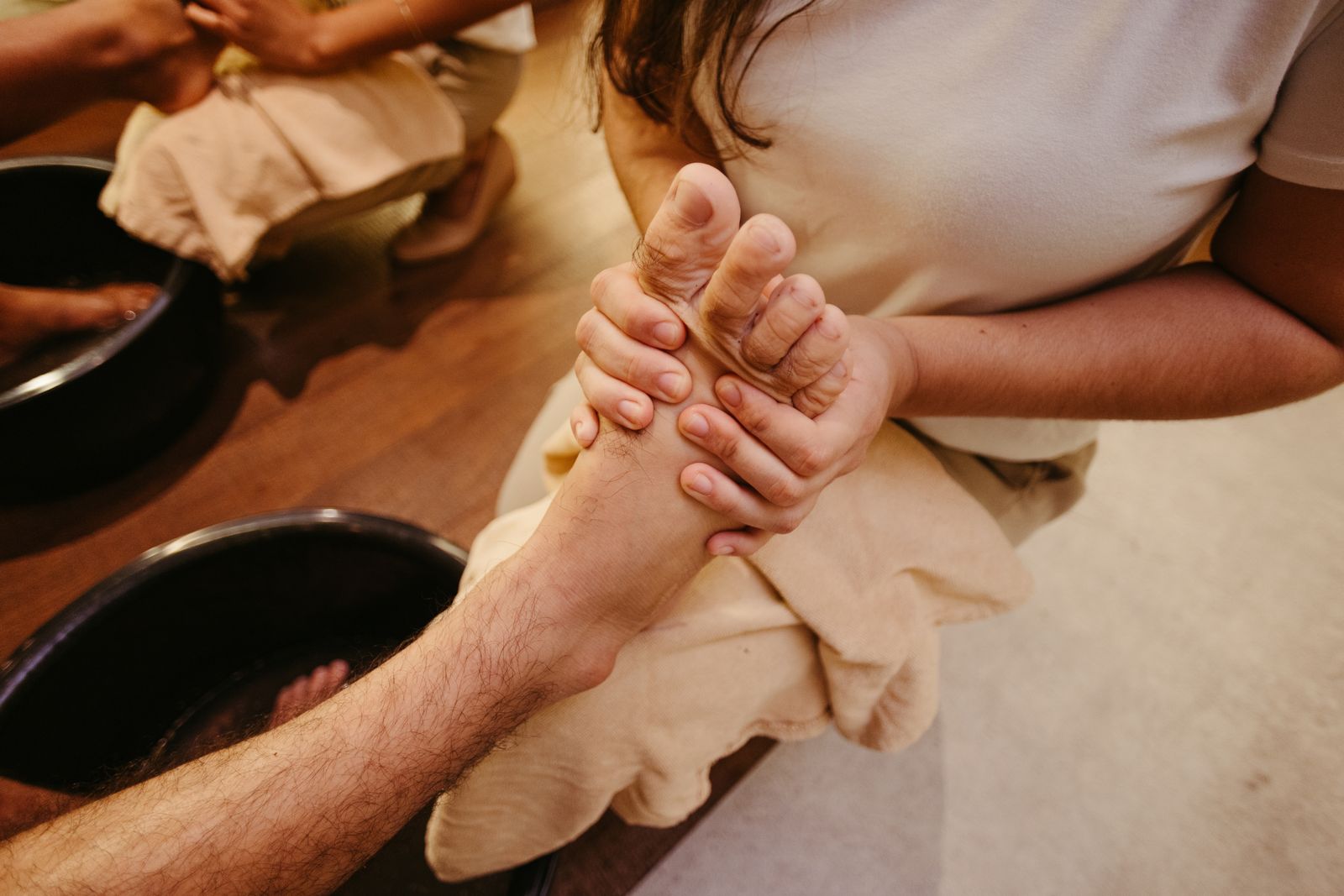
Foot soaking (pao jiao, 泡腳) is the simplest habit for cold feet: warming them draws blood to the surface and signals the body to wind down. Fill a basin with water at about 38–42°C (test with your elbow — never start so hot it stings), deep enough to cover the ankles, adding fresh ginger slices or a handful of mugwort (艾葉) if you like. Soak 15–20 minutes, one to two hours before bed; dry thoroughly, massage Yongquan (KI1) on each sole, then put on socks.
With diabetes, neuropathy, or circulation problems, ask a doctor before soaking, and never soak broken skin or swollen, painful feet.
Gentle Movement: Qigong and Baduanjin
Stillness is the enemy of warmth: after hours of sitting, nothing pumps the channels that carry qi and blood.
Baduanjin (八段錦), the “Eight Pieces of Brocade,” is a ten-minute qigong form needing no equipment. Its opening movement, “Two Hands Hold Up the Heavens” (兩手托天), stretches the whole torso and is said to move warmth through the body’s three cavities. Slow walks, ankle circles, and desk finger flexes all count — the goal is gentle daily motion from core to fingertips.
Small Daily Habits That Keep the Cold Away
- Sleep before 11 p.m. — deep rest replenishes the blood and yin the extremities draw on.
- Dress the ends — warm socks, warm palms, and slippers off cold floors prevent the chill before it starts.
- Skip iced drinks — protect the digestive fire that makes the qi and blood your hands need.
- Breathe through stress — slow diaphragmatic breaths counter the liver-qi traffic jam.
When to See a Doctor
Cold hands and feet are often harmless — a cold room, a light diet, or a slim build explains them. But they can also signal real conditions such as anemia, an underactive thyroid, Raynaud’s phenomenon, peripheral artery disease, or nerve problems, so treat TCM patterns as traditional concepts rather than diagnoses.
Seek medical care if coldness comes with leg pain when walking, numbness, color changes in the fingers, slow-healing skin, coldness on only one side, or fatigue with weight change. Tell your doctor about any herbs you take, and use TCM as complementary care (NCCIH on acupuncture).
The Bottom Line
Cold hands and feet have a clear logic in TCM: warmth is not reaching the ends of the line because the furnace (yang) is low, the fuel (qi and blood) is scarce, or the road is blocked (liver qi stagnation). The traditional response is gentle and cumulative — warming foods like ginger, longan, and lamb-and-angelica soup; daily acupressure on KI1, CV4, ST36, and PC8; an evening foot soak; and slow movement like baduanjin.
None of this is a quick fix or a replacement for medical advice. Used sensibly, though, these habits turn winter self-care into a daily ritual that supports the whole body.